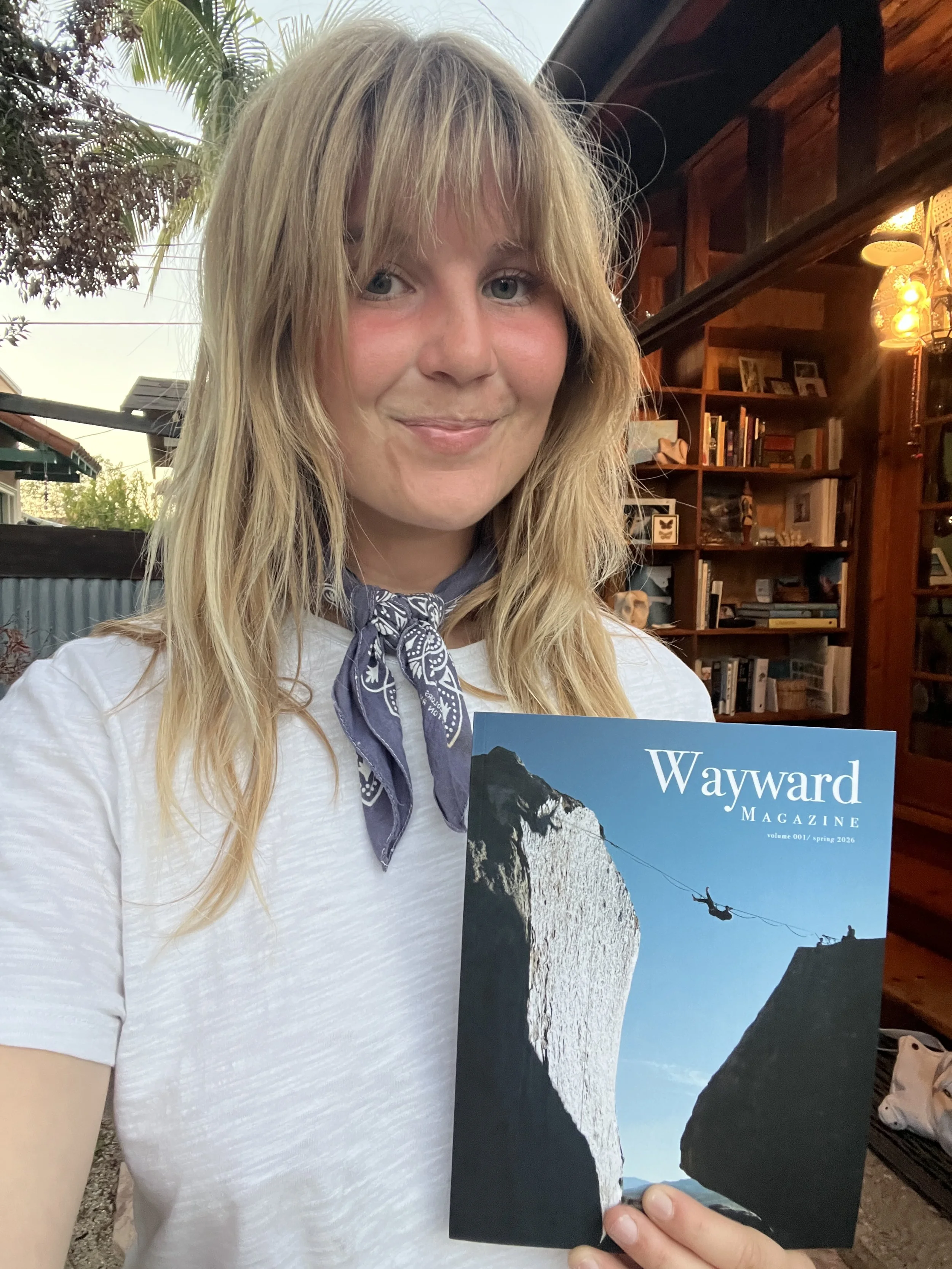
“To create art, the body must seek it out and embody it...”
Written by Angie Stevens | November 13
It’s finally getting cold here along the central coast of California. As someone who wakes each day yearning to create, there are seasons of increased input and output for me—stretches of time where my mind wants to notice, experience, and swallow huge breaths of inspiration, and stretches of pure and untamed exhalation. I hoard my ideas during the long, yawning summer days, and once the evenings grow longer, I’m ready to piece together my personal creations, pulling from this teeming library I’ve cultivated.
From sending volume 001 of Wayward to print in July to this dear Friday in mid-November, I’ve gotten to recenter myself and my ideas. I’ve escaped the country to go climb, spent countless hours in the ocean, and settled back into routine as a recent college grad. Now, I’m ready to dive back in, fully.
Cutting ties with the constant stream of intake and digital inspiration, I’ve got physical mood boards printed and pasted on my walls, with dozens of screenshots from print magazines I own and notes about spread designs, table of contents, page numbers, logos, fonts, story titles, captions, etc.…..
I am crafting up a piece that I will share next week about a whole bunch of print publications I treasure, and derive such value and meaning from. For now, in this week’s Letter I wanted to share the editor’s note I wrote from Vol. 001. Through all my rambling, it feels like it still rings true as the guiding principle of my creative process.
❖
The “human paradox of altitude,” British writer and mountaineer Robert Macfarlane muses in his book Mountains of the Mind: A History of a Fascination, “both exalts the individual mind and erases it. Those who travel to mountain tops are half in love with themselves, and half in love with oblivion.”
Wading deeper into wild landscapes, high places, fluid places prone to motion, empowers. “But in a way, too, it obliterates you,” says Macfarlane. “Your sense of self is enhanced because of its extended capacity for sight, but it also comes under attack—is threatened with insignificance by the grand vistas of time and space.”
The roaring call of the body to such places that emit immeasurable physicality, form, and awe, is a centuries-old resonant sound. Mountain folk have toggled between the throes of fear and frenzy, and the triumphs of meeting human aspirations in the alpine, ever since the early 17th-century perception of mountains as repulsive blemishes occupied the Western consciousness.
A piqued fascination—and stronger research pointing to mountains as not immovable ‘eyesores’ but constantly changing peaks—grew as writers and scientists of the mid-1700s showered these incomprehensible places in a romanticized light. These scenes, shaped by the jostling of continental plates and filled with unknown, were and are thus malleable to the mind, and in turn shape the malleable mind into something of itself.
Seekers of the greater heights find themselves face-to-face with a grand duality: the irresistible call to ascend, contrasted with the hum of ever-present dangers awaiting. This fatal attraction, as Macfarlane writes—and I contemplate, after deeply moving moments in the mountains—conjures up a very real, very powerful reflection of the self, and shoots it back with an intensity unlike any perfect mirror, ‘til one’s fears, longings, limits, and desires are pooling at one’s boots.
///
It’s invigorating, addicting even, to meet up with yourself in the outdoors in a way unfathomable when carrying out the regular day-to-day craziness in buzzing cities or lifeless cubicles. I’m convinced in the mountains—or racing down green gravel bike trails, or sitting out on a board far from shore—I step back into the version of myself that feels most whole, most honest.
For a while I believed that part of myself didn’t come home with me after I drove away from the mountains, or paddled in. But I’ve come to discern noise from absence, and recognize that existing intentionally outside removes the former and opens the channel for so much life to rush in. And the sensory experience of being in wild places, instead of doing (bagging peaks, checking boxes, chasing records), is slower and wades deeper into the physicality of what it really means to be human.
“To create art, the body must seek it out and embody it: the slowness, the silence or grumbling yawns of rivers, whispering leaves or curious fawns,” Scottish writer and poet Nan Shepherd wrote in her memoir The Living Mountain. The Cairngorm Mountains of Scotland were her stomping grounds, and in her least-known piece of prose written in the last years of the Second World War, she details getting to know the land “deeply” not “widely,” “walking in” rather than “climbing up,” to immerse the senses and surrender the entire body to the mountain.
This magazine volume holds up as a strong testament towards this. The creative process and final outcome for the 33 contributors varied in shape and form, but each toiled with the question of why we seek these outdoor spaces, and what we find at the core of our passion. It required presence in the body to create art and derive meaning; a playdate with one’s senses if you will.
In reflecting on surfing or shaping boards along the Central Coast, contributors had to first open themself up to feeling the interplay of calculated balance and surges of raw energy, and start to imagine the fickle waves crumbling underfoot. To write of highlining in Yosemite Valley, some had to return to the breath, and the calm required to take the next step far above the valley floor. To select the best photographs from a seven-week bike packing trip across New Zealand, one writer had to first sink back into his memory, re-taste freedom on the tongue, and thereafter choose the collection of images that best embodied those bygone days. Some invited in the crackling bonfires and smiling faces aglow in the Buttermilks before meditating on the climbing community and the space it holds deep in the heart. Another welcomed back the stark silence of the Mojave Desert to communicate his work studying noise pollution and Burrowing Owls in between days of climbing with friends.
As a climber, writer, and lover of all things print, I believe that most authentically exploring the physicality of these outdoor activities and our underlying connection point feels only right if presented in an equally tangible, raw form.
Your copy may fade and fray at the edges as pages are thumbed through by calloused hands. But granted it was never made to stay the same. Let this volume remind you of this: the ever-changing nature outside and inside the body. Let it breathe some life back in and remind you of your wild, wayward spirit.
Angie Stevens
Editor